The Planetary Health Diet allows for large amounts of milk consumption, seemingly suggesting that milk is an integral part of a sustainable diet. This blogpost dives into what the Planetary Health Diet is, how it is commonly misunderstood, and how milk creates tensions between optimizing for health or for sustainability.
A healthy diet with an environmental bycatch
Since its conception in 2019, the Planetary Health Diet (PHD) by the EAT-Lancet Commission has emerged as the ultimate yardstick of dietary advice. In a context where 27% of annual deaths worldwide are caused by unhealthy eating1, and 30% of greenhouse gas emissions are caused by the food system2, scientifically rigorous guidance on healthy and sustainable food is more urgent than ever.
However, despite its confusing name, the PHD was not developed or optimized around sustainability or planetary boundaries. It was created by a team of world-leading health experts, and the resulting dietary recommendations are only derived from direct impacts on human health (and not from impacts on the environment). The guiding principle in the development of the PHD was the minimization of illness and mortality, not the minimization of emissions, pollution, and land use.
Still, the message behind the PHD is that health and sustainability go hand in hand. And indeed, in the 2025 update by the EAT-Lancet Commission, no less then ten economic models and a dietary impact model convincingly demonstrate that a world in which we all eat according to the PHD3 will have lower emissions, lower water pollution and extraction, and lower rates of biodiversity loss.
This is largely driven by the fact that the most unsustainable food group, red meat, is also the most overconsumed one. The healthy range of red meat consumption in the PHD is a meagre 0-30 g/day. The reference target, 15 g/day, is equivalent to only half a spoon of ground beef. Cutting red meat consumption and production to these healthy levels would see the global ruminant (cattle, sheep and goat) population drop by 26%.
In the food system, the livestock industry is the main driver of global heating, deforestation, pollution and biodiversity collapse. Therefore, for red meat, health and sustainability are perfect allies, and the point that the PHD is optimized around health and not around sustainability may amount to pedantry.
Milk and the limit of health-sustainability exchangeability
The story becomes less trivial for milk. The recommended daily intake is 250 g/day with a range of 0-500 g/day. This means that a life without milk can be healthy, but consuming up to a half kilogram per day can be too4. The nuances, provided by the PHD-experts, are important here: many people around the world do not consume milk as part of their traditional or chosen diets, and around 65-70% of people globally are lactose-intolerant5.
The PHD does not advise these people to drink 250 g/day of milk (contrary to what some voices in the dairy industry suggest6). While many people take the 250 g/day recommendation at face value, people consuming less than that are not milk-deprived or necessarily unhealthy. In fact, if the 250 g/day target would be adopted globally, this would result in an increase in global milk consumption and associated livestock numbers.
So the PHD does not directly advise anyone to increase their milk consumption. But at the same time, it sets the ambition for moving away from dairy very low. Clearly, from an environmental perspective, a smaller global dairy herd is preferable7, and the lower end of the 0-500g range will be more sustainable in most contexts. But because the PHD was not developed from an environmental perspective, it does not advise people consuming within this range to further decrease their milk consumption. This is a missed opportunity.
This is apparent from the assumptions used to calculate the environmental impacts of the PHD. To model the environmental benefits of a global PHD adoption, the researchers leave the intake of food groups unadjusted for a population if it is already in the healthy range8. This implies that, as long as a population consumes less than 500 g/day of milk (so, within the 0-500 g/day range), the EAT-Lancet models consider that acceptable.
Although recent and reliable data is missing, a rough analysis9 shows that only 40 countries have an average per-capita milk consumption of more than 500 g/day. When the EAT-Lancet researchers estimate the environmental benefits of a dietary shift, for milk, a reduction is only assumed for those 40 countries, and only to the 500 g/day upper limit10.
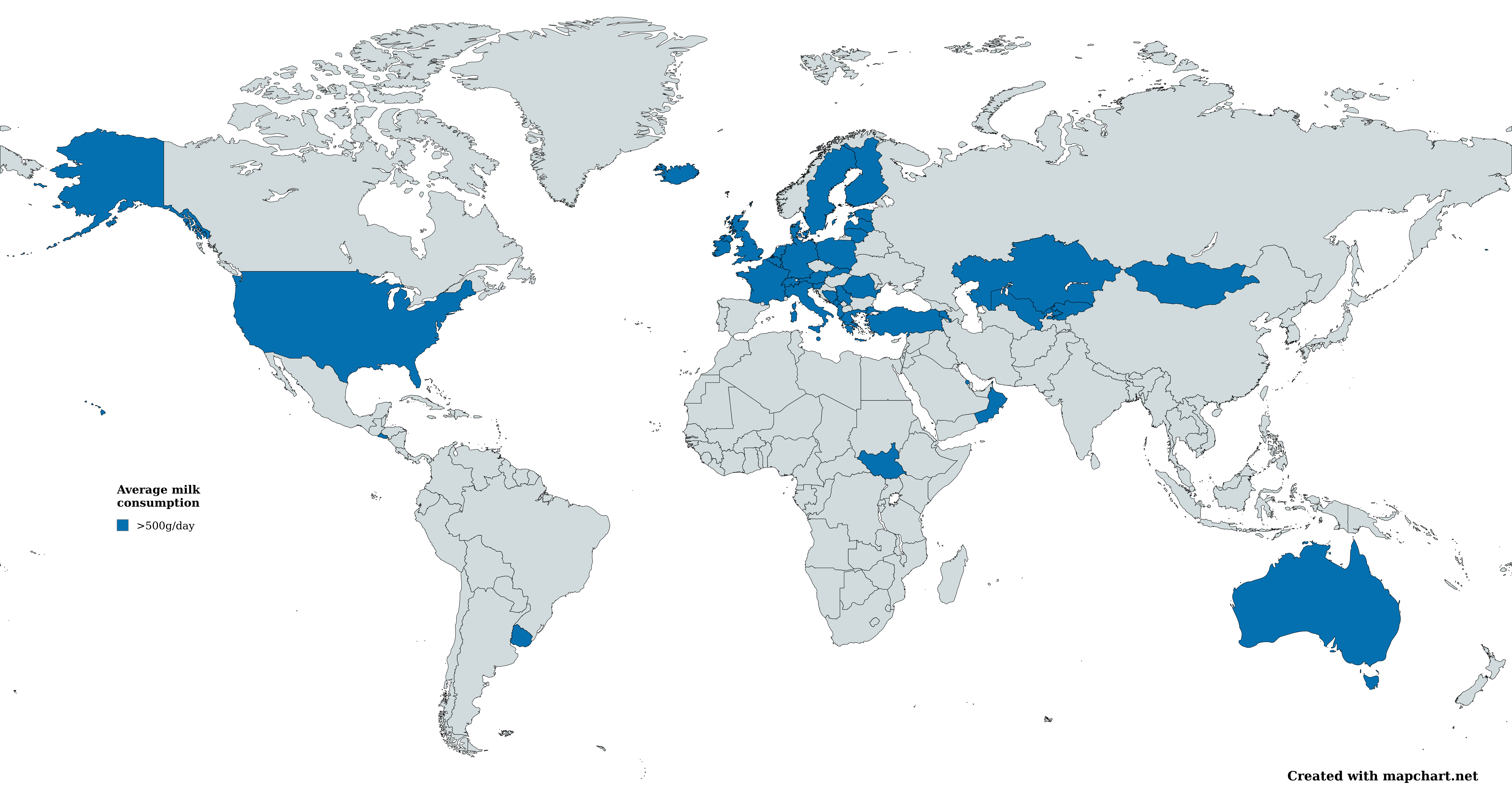
This severely downplays the potential of a shift away from dairy. By EAT-Lancet’s own calculations, the global dairy herd would shrink by only 4%11. Further reductions are certainly possible, but because these would be health-neutral, they are not considered in the Commission’s analysis (although they are hinted at as a theoretical mitigation option on page 18).
What does this imply?
First, while milk can be part of a healthy diet, it remains a highly unsustainable method for protein supply12. Those stating that the PHD proves that milk is a necessary part of a sustainable diet, or that the PHD demonstrates a global shortage of milk, are overstretching the findings of the EAT-Lancet Commission (and might be trying to sell milk).
Second, the PHD is better for the environment, but better is not the same as sufficient. The climate crisis and the collapse of global ecosystems require urgent and drastic measures to avoid tipping points and to maintain a liveable planet. Whether it’s the recent science on the plausible imminence of an AMOC collapse, the destruction of lives and livelihoods by massive floods last month in Southern Africa, or the simple fact that we are seemingly speedrunning towards 1.5°C of global heathing: it is clear that we require drastic measures. Steering milk consumption towards the lower end of the 0 – 500 g/day range is more in tune with the speed and scale of action required13.
Footnotes and references
Edits Fixed footnote 4 and image caption to better reflect the data source
-
EAT-Lancet Commission 2025 report, Page 5 ↩
-
Crippa et al. (2021). Food systems are responsible for a third of global anthropogenic GHG emissions. Nature Food ↩
-
Combined with a host of improved agricultural and supply chain practices ↩
-
The global average milk supply per capita is 225 g/day. In te Netherlands, adults eat 723 g/day on average (data: Our World in Data, although different sources vary in their estimates ↩
-
Bayless et al. 2017. Lactase Non-persistence and Lactose Intolerance. Current Gastroenterology Reports ↩
-
See for example the response to the 2019 EAT-Lancet report by the International Dairy Federation and the Global Dairy Platform claiming that EAT-Lancet proves that dairy “contributes to sustainable diets” ↩
-
Harwatt et al., 2024. Options for a Paris aligned livestock sector. Harvard Law School ↩
-
See appendix 5, p13 of the EAT-Lancet Commission report ↩
-
Based on Our World in Data and sourced from FAO, Not corrected for age and gender distribution, among other lacunas. ↩
-
This is what I can interpret from the appendices. ↩
-
EAT-Lancet Commission 2025 report, Panel 7, p. 28 ↩
-
In most contexts and for most people. In some contexts, dairy herds are the only feasible source of protein. ↩
-
Especially because methane emissions from livestock, due to their high warming potential and shorter amospheric lifetime are an effective emergency brake for the climate system. ↩