We urgently need to get fossil fuels out of our food system. Our reliance on gas-derived synthetic fertilizers to grow food is not only incompatible with a safe climate, it also exposes us to dangerous volatility and jeopardizes food security. Speculative promises of future technofixes by the fertilizer industry fail to offer feasible solutions and tend to swap one problem for another.
Meanwhile, organic farmers have optimized a largely fossil-free form of agriculture for decades. Their agro-ecological know-how, combined with a shift to more plant-based diets, are under-recognized solutions towards a fossil-free world.
We grow food with fossil fuels
Synthetic nitrogen fertilizer is made in a highly energy-intensive process, where fossil methane is used both as a fuel and as a feedstock. This causes 2% of global greenhouse gas emissions and uses about 5% of global fossil gas supply (CIEL, 2022). On top of that, when fertilizer is applied on croplands, this emits high amounts of nitrous oxide (N2)O, a greenhouse gas 300 times more potent than CO2 (Chrobak, 2021). This makes fertilizer production in its current form incompatible with a fossil-free world.
Synthetic nitrogen fertilizer production involves a chemical procedure to turn the abundantly available nitrogen in the atmosphere (N2) into ammonia (NH3). In this process, hydrogen (H2) is required. Because hydrogen does not occur naturally on earth, it is instead created from methane (CH4), which is fossil gas, acting as both heating fuel and ingredient. The resulting hydrogen is then combined with the nitrogen occurring abundantly in the atmosphere (N2) to create ammonia (NH3).
For a chance to stay within safe climate limits, we need to reduce emissions urgently and leave a majority of known fossil fuel reserves in the ground (Welsby et al. 2021). This creates a huge challenge for agriculture: Conventional, chemical agriculture runs on fossil‑derived synthetic fertilizer. To keep global warming within safe limits—and to leave the bulk of known fossil reserves underground— agriculture has to wean itself of fossil fuels.
Beyond the climate imperative, a fossil-reliant food system ties food prices to gas prices, leading to instability and food insecurity (Duhalt et al. 2023). The current closure of the Strait of Hormuz is choking off a major supply line of both gas and synthetic fertilizer. This is already leading to a spike in fertilizer prices, which will lead to higher food prices and, ultimately, to increased hunger (The Guardian, 2026). This repeats the 2022 food price hike driven by gas supply disruptions due to the war on Ukraine, which drove millions into extreme hunger (Welsh, 2024). Rather than feeding the world, fossil fertilizers create inherent instabilities that undermine food security.
Technological wack-a-mole
Faced with the reality that decarbonisation and a fossil fuel phaseout are both desirable and increasingly inevitable, the fertilizer industry is exploring alternatives, insofar as these alternatives do not undermine their basic business model. Three avenues are being explored to avoid the industry’s phase-down.
First, blue hydrogen keeps the system tied to fossil gas, but captures and stores that emitted CO2. But even if CO2 is captured, extracting, transporting and processing the gas still releases a lot of emissions (Howarth and Jabobson, 2021), and the potential to store captured carbon securely over the long term is vastly overestimated by industry (Gidden and Rogelj, 2025). Blue hydrogen sustains fossil dependence and cannot be scaled reliably, casting serious doubt on its promised benefits (Martin-Roberts et al., 2021). It is a solution inasmuch as a bucket is a solution to a leaky roof (and in this analogy, it’s one bucket and multiple leaks).
The second proposal is the use of green hydrogen. This is a fossil-free technology, as the hydrogen is no longer created from (fossil) methane, but instead from electrolysis using renewable energy. However, electrolysis is highly energy-intensive, and uses vast amounts of water.
To generate the current supply of synthetic nitrogen fertilizer (conservatively estimated at around 100 million tonnes of ammonia per year; FAO, 2019), at an estimated energy requirement of 12000 kWh ton-1 (Ghavam et al., 2021), would require 1.2 billion kWh yr-1 of electricity. This is more than half of current global solar power generation, and roughly half of global wind power generation (Ritchie et al., 2024). Note that green hydrogen is the aspirational cornerstone of decarbonization for multiple other industries as well, including aviation and steel production. 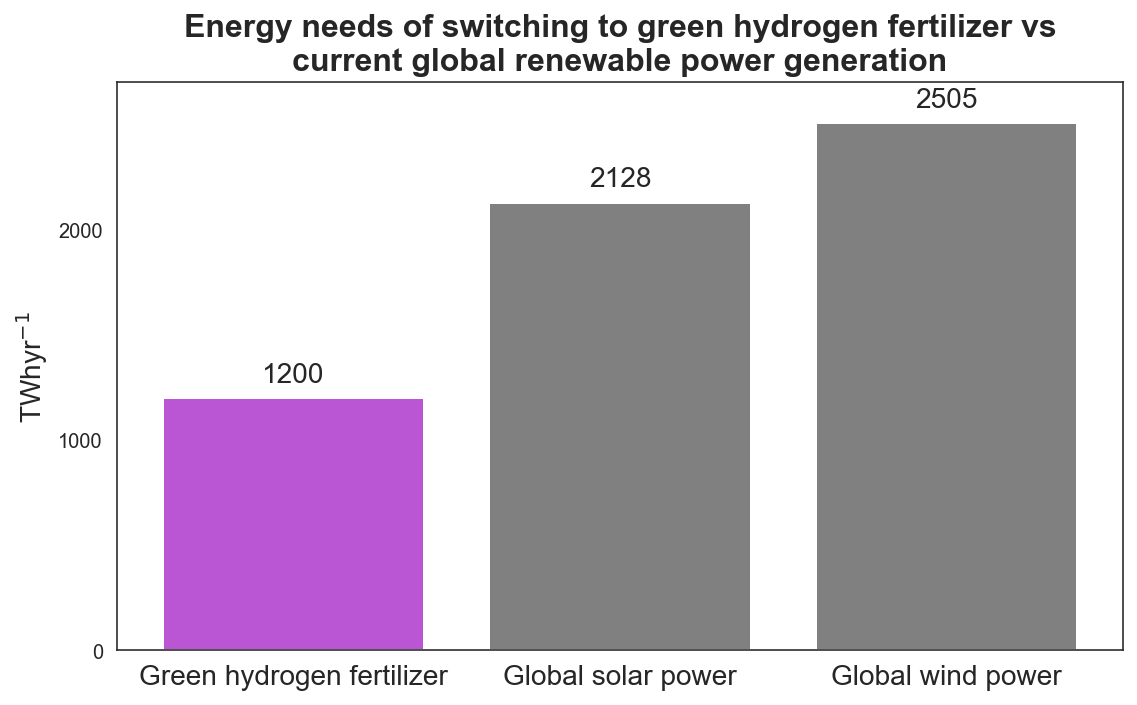 The required power generation to generate all current synthetic fertilizer production to green hydrogen, compared with current global renewable power generation. Own estimation based on sources above, renewables data: Our World in Data
Switching to green hydrogen would require earmarking a significant part of current and future renewable capacity, only in the service of fertilizer production, and would therefore be in competition with other societal needs. Because conventional fertilizer plants cannot readily switch to green hydrogen, they need to be retrofitted or rebuilt, further increasing cost. Green hydrogen’s role in fertilizer production will be limited at best.
A third solution switches the fossil methane for biomethane (also known as renewable natural gas). Here, biogas is created from biomass (crops, livestock manure, or forest residues), and then purified into biomethane. This solution puts fertilizer production in direct competition with food and nature, and exchanges a fossil problem for a land use problem.
The amount of land and water needed to grow this required biomass is astronomical. For a ton of ammonia, between 637 and 2894 square meters of land and between 248 and 4727 ton of water are required (Mingolla and Rosa, 2025). To switch current fossil methane use for synthetic fertilizer production to biomethane would require a land area the size of France (best-case) or India (worst-case).
If the biomethane is sourced from livestock manure, we would need to keep livestock numbers high to ensure a steady supply (Magnolo et al., 2024). Yet these high livestock numbers are a major driver behind deforestation, biodiversity loss, water pollution, air pollution, animal suffering, and, importantly, greenhouse gas emissions. Consequently, tying synthetic fertilizer production to the livestock industry locks in environmental calamity on multiple fronts.
Most concerning, for all three solutions, the nitrous oxide emissions in the use-phase of the fertilizer remain completely unaddressed. High-tech solutions under the umbrella of precision agriculture can reduce these emissions, but only by an estimated 26% from current levels at best (Winiwarter et al., 2018). The solutions proposed by the fertilizer industry currently only live on PowerPoint slides and the occasional pilot projects (which are increasingly being discontinued, Morgan 2025). They amount to a game of whack-a-mole, creating multiple new problems for every issue they ostensibly solve. Blue hydrogen maintains the fossil dependency, green hydrogen lays claim to vast renewable resources, and biogenic methane perpetuates the environmental issues inherent to industrial livestock rearing.
Fertilizers mostly feed animals, not humans
There is a sense of defeatism in the discourse around synthetic fertilizers. The issues with their production and use are widely accepted, but they are seen as a necessary evil because the crops they help grow are needed to feed the world. Without synthetic fertilizer, it is said, Malthusian hunger is at the door.
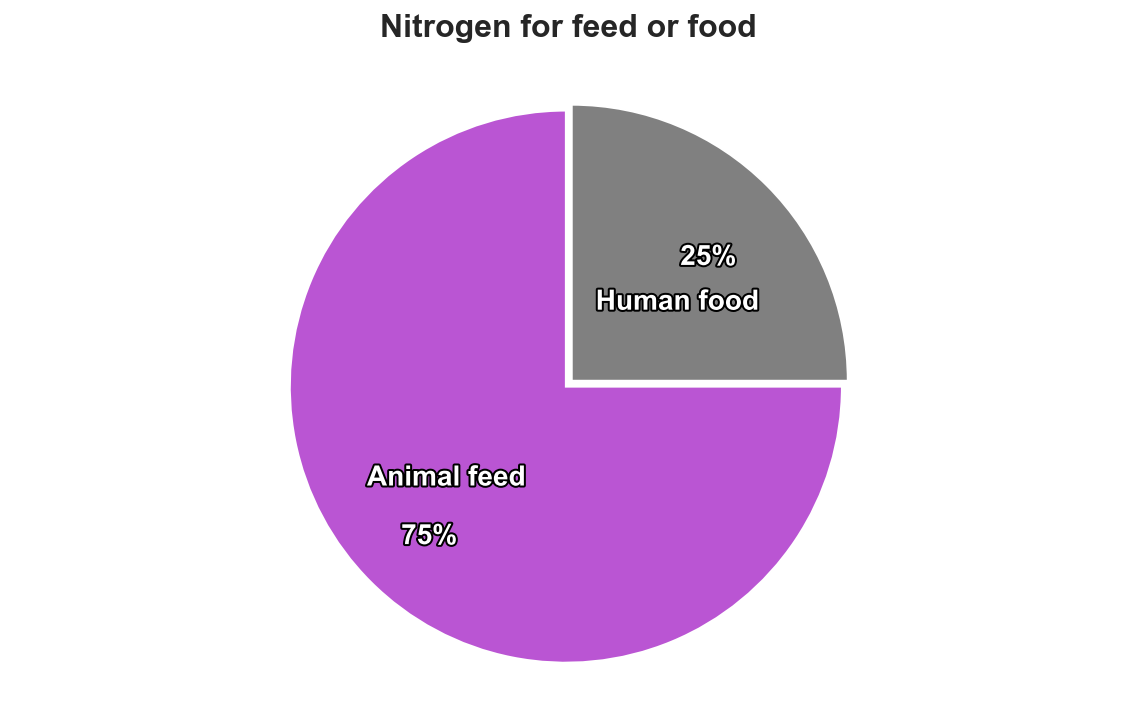
Certainly, increased yields have allowed us to produce more crops, and expand agriculture into areas with nutrient-poor soils. However, much of this added production is used to feed livestock, not humans. Three quarters of nitrogen added to croplands is used to produce animal feed, not human food (Menegat et al., 2022).
In the United States, half of fertilizer is applied to grow maize, and in New Zealand, 90% is used on grassland. The availability of fertilizer allowed some parts of the world to develop a wildly inefficient food system, maintaining a livestock herd that would be impossible to feed without fertilizer. Seen this way, synthetic fertilizer is a chief enabler of livestock emissions, making a decrease in livestock numbers a double win for the climate (Viglione, 2022).
On the bright side, this means that a large chunk of our fertilizer consumption can be avoided by simply switching to a healthy diet low in animal products. In the European Union, for example, about 72 % of agricultural land is used for meat and dairy production (Greenpeace, 2019). If that land were redirected toward growing food for people, we could abandon the ultra‑intensive monocultures that rely on heavy fertiliser use and instead adopt lower‑input, organic farming practices.
Organic agriculture is a climate solution
Even deeper cuts in fertilizer use can be achieved by expanding and further innovating organic agriculture. The integration of livestock and cropland farming, the use of crop rotations, and improved soil management allow farmers to grow crops without fossil-based fertilizers.
Organic agriculture is often scoffed at for being overly land-hungry, owing to its somewhat lower yields. At first glance, that could seem to threaten natural habitats and exacerbate climate pressures. Yet because it avoids fossil-based substances and the significant emissions associated with their production and use, organic agriculture has major (and often underappreciated) climate benefits. When paired with dietary shifts, the yield gap can be closed without expanding farmland. In this way, organic farming becomes a cornerstone of a truly fossil‑free food system and a powerful climate‑mitigation strategy.
The (to my knowledge) most nuanced research on the potential of organic agriculture (Barbieri et al., 2021) suggests that 60% of global agriculture could be switched to organic management (compared to 2% currently) without jeopardizing global food sufficiency, when combined with dietary changes and cuts in food waste. Further innovation, notably around closing the nitrogen cycle and improving crop rotations, may allow for further cuts in synthetic fertilizer use.
Closing thoughts
Organic agriculture is not a silver bullet solution, and any transition to organic agriculture needs careful planning and strong governance. Overhauling our diets and farming methods is by no means easy. However, in contrast to the pie-in-the-sky proposals of the fertilizer industry, it is technically feasible, relatively cheap, and tested at scale.
Necessity is the mother of progress. As long as we allow the fertilizer industry to hijack the option space for the future of farming, we fail to give true alternatives fertile ground to thrive. But when we acknowledge that the future will need to be largely free of synthetic fertilizers, we can build a fossil-free food system.
References
Barbieri et al., 2021. Global option space for organic agriculture is delimited by nitrogen availability. Nature Food
Chrobak, 2021. The world’s forgotten greenhouse gas. BBC
CIEL, 2022. Fossils, Fertilizers, and False Solutions: How Laundering Fossil Fuels in Agrochemicals Puts the Climate and the Planet at Risk. Center for International Environmental Law
Duhalt et al., 2023. Fertilizer Woes at the Energy-Food Nexus. Energy Explained, Columbia University
FAO, 2019. World fertilizer trends and outlook to 2022. FAO
Ghavam et al., 2021. Sustainable Ammonia Production Processes. Frontiers in Energy Research
Gidden & Rogelj, 2025. How the role of carbon storage has been hugely overestimated. Carbon Brief
Greenpeace, 2019. Over 71% of EU farmland dedicated to meat and dairy, new research. Greenpeace European Unit
The Guardian, 2026. ‘A big burden for farmers’: Gulf shipping crisis threatens food price shoc. The Guardian, March 5, 2026
Howarth & Jacobson, 2021 How green is blue hydrogen? Energy Sci Eng
Magnolo et al., 2024. Biomethane from manure in the RePowerEU: A critical perspective on the scale-up of renewable energy production from the livestock sector. Energy Research & Social Science
Martin-Roberts et al., 2021. Carbon capture and storage at the end of a lost decade. One Earth
Menegat et al., 2022. Greenhouse gas emissions from global production and use of nitrogen synthetic fertilisers in agriculture. Scientific Reports
Mingolla & Rosa, 2025. Low-carbon ammonia production is essential for resilient and sustainable agriculture. Nature Food
Ritchie et al., 2024. Renewable Energy. Our World in Data
Welsby et al., 2021. Unextractable fossil fuels in a 1.5 °C world. Nature
Welsh, 2024. Russia, Ukraine, and Global Food Security: A Two-Year Assessment. Center for Strategic and International Studies
Morgan, 2025. Green hydrogen is not a silver bullet to decarbonize the fertilizer industry. Clean Energy Group
Viglione, 2022. What does the world’s reliance on fertilisers mean for climate change? Carbon Brief
Winiwarter et al., 2018. Technical opportunities to reduce global anthropogenic emissions of nitrous oxide. Environmental Research Letters